This guide provides a practical checklist for inspecting wholesale mobile phone batteries, covering capacity, voltage, safety, compatibility, packaging, QC, and supplier evaluation. Learn how to reduce quality risks, control costs, and choose a reliable battery supplier for your wholesale business.
Wholesale Mobile Phone Batteries Inspecting Checklist
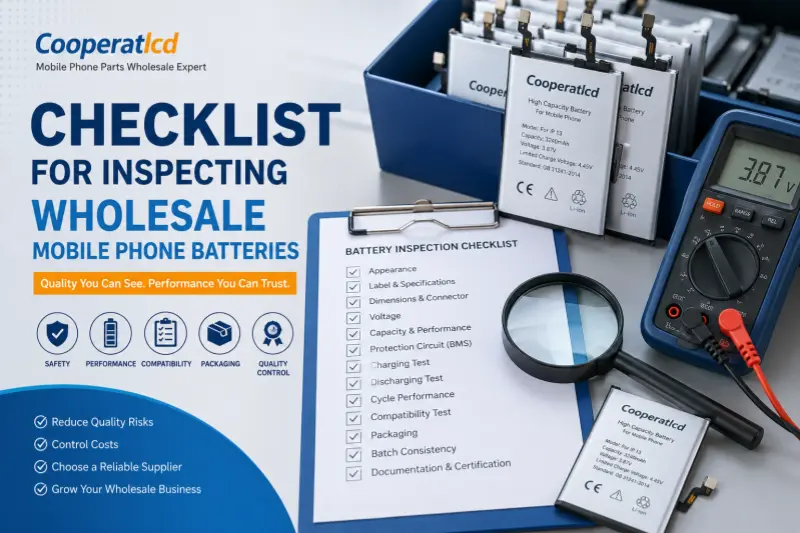
For mobile phone repair shops, distributors, and wholesalers, battery quality directly affects
customer satisfaction,
replacement rates,
warranty costs, and
long-term profitability. When purchasing batteries in bulk, checking only the printed capacity or unit price is not enough.
A
reliable wholesale battery inspection process should cover
appearance,
labeling,
specifications,
electrical performance,
safety,
compatibility,
packaging,
batch consistency, and
supplier quality control.
This guide provides a practical checklist for inspecting
wholesale mobile phone batteries and explains what bulk buyers should verify before placing a large order.
Why Battery Inspection Matters for Wholesale Buyers
Buying hundreds or thousands of batteries is very different from buying one battery for personal use.
A small defect rate can become a significant business cost when multiplied across a large order.
For example, if you purchase 2,000 batteries and even 2% have quality problems, that could mean approximately 40 units requiring replacement, refund, or customer service.
More importantly, poor-quality batteries may result in:
- Short battery life
- Unexpected shutdowns
- Charging problems
- Excessive heating
- Battery swelling
- Inaccurate battery percentage readings
- Poor compatibility with certain phone models
- Higher return and warranty rates
- Damage to your reputation with repair customers
Therefore, battery inspection should be considered part of your
procurement process, rather than something done only after customers report problems.
Wholesale Mobile Phone Battery Inspection Checklist
Before accepting a bulk shipment, buyers should inspect the following areas:
| Inspection Area |
What to Check |
Why It Matters |
| Appearance |
No swelling, dents, scratches, or leakage |
Identifies physical defects |
| Labeling |
Model, capacity, voltage, manufacturer information |
Confirms product identity |
| Dimensions |
Length, width, thickness, connector position |
Ensures physical compatibility |
| Capacity |
Rated capacity and actual performance |
Determines battery life |
| Voltage |
Rated and operating voltage |
Prevents compatibility problems |
| Connector |
Pin layout, connector position, contacts |
Ensures proper installation |
| PCB/BMS |
Protection board and components |
Critical for safety |
| Charging |
Charging behavior and temperature |
Detects electrical problems |
| Discharging |
Runtime and voltage stability |
Evaluates performance |
| Cycle Performance |
Capacity retention after cycles |
Indicates long-term quality |
| Packaging |
Individual and carton packaging |
Protects batteries during transport |
| Batch Consistency |
Samples from different cartons |
Identifies inconsistent production |
| Documentation |
Test reports and certifications |
Supports compliance and traceability |
Let's examine each point in detail.
Step 1: Check the Battery's Physical Appearance
The first inspection should be a simple visual and physical examination.
Before connecting the battery to any testing equipment, check whether the battery itself appears normal.
Look for:
- Swelling or bulging
- Deformation
- Cracks
- Punctures
- Scratches on protective film
- Damaged edges
- Exposed wires
- Loose connectors
- Corrosion
- Leakage
- Burn marks
- Damaged insulation
- Uneven surfaces
A battery should normally have a
flat and consistent appearance.Any battery showing obvious swelling, physical damage, leakage, or damaged insulation should be separated immediately.
Important:Do not attempt to charge or install a battery that has obvious physical damage.
For large shipments, visual inspection should be performed on every unit where practical, particularly when the supplier's quality history is not yet established.
Step 2: Verify the Battery Label
The printed information should match your purchase order and product specification.
Check:
- Battery model
- Compatible phone model
- Rated capacity
- Rated voltage
- Battery type
- Manufacturer or supplier information
- Production information, where applicable
- Safety markings
- Certification markings, where applicable
- Batch or lot number
For example, if you ordered a battery designed for a particular iPhone or Samsung model, the battery label, packaging, and SKU should all correspond to the same product.
Watch for inconsistent labelingA common problem in wholesale procurement is receiving products that look similar but belong to different specifications.
For example:
Purchase order: Model A battery, 4,500 mAh
Received product: Model A-compatible battery with a different capacity or connector specification.
This can create compatibility and warranty problems even if the batteries look almost identical.
Step 3: Verify Rated Capacity
Capacity is one of the most important specifications for a phone battery.
It is commonly expressed in:
mAh — milliampere-hoursHowever, wholesale buyers should not judge battery quality solely from the capacity printed on the label.
A battery labeled with a higher capacity does not automatically provide better real-world performance.
Check:
- Rated capacity
- Typical capacity, if specified
- Actual measured capacity
- Testing conditions
- Capacity tolerance
- Consistency between samples
For bulk purchasing, ask the supplier how capacity is measured and what testing equipment and conditions are used.
Why this mattersTwo batteries can both be labeled 5,000 mAh, while their actual performance may differ significantly.
Therefore, professional buyers should evaluate
measured capacity rather than relying solely on printed specifications.
Step 4: Check Voltage
Battery voltage must match the requirements of the intended phone model and battery design.
Check:
- Rated voltage
- Charging voltage
- Cut-off voltage
- Voltage consistency between samples
A mismatch can cause:
- Charging problems
- Abnormal battery percentage readings
- Poor performance
- Excessive heating
- Protection-board activation
- Potential safety problems
The exact acceptable voltage range depends on the battery chemistry and design, so buyers should compare measurements with the manufacturer's technical specification rather than applying one universal voltage value to every phone battery.
Step 5: Inspect the Connector and Physical Dimensions
A battery can have excellent electrical performance and still be unusable if it does not physically fit the phone.
Check:
Physical dimensions
- Length
- Width
- Thickness
- Shape
- Position of tabs or adhesive areas
Electrical connection
- Connector type
- Connector position
- Pin configuration
- Contact quality
- Flex cable design
- Connector locking/fit
The battery should fit correctly without excessive force.
Never rely only on the model name. Some phone models may have different battery versions, revisions, or regional variations.
For wholesale purchasing, sample installation testing is strongly recommended before confirming a large order.
Step 6: Inspect the Protection Circuit and BMS
The battery's protection circuitry is one of the most important components from a safety perspective.
Depending on the design, the protection system may help manage conditions such as:
- Overcharge
- Over-discharge
- Overcurrent
- Short circuit
- Abnormal operating conditions
Buyers should ask suppliers what protection functions are incorporated into the battery design.
Where technically appropriate, inspect:
- Protection PCB
- Components
- Soldering quality
- Insulation
- Wiring
- Connector solder joints
- PCB protection
- Component consistency between batches
For high-volume procurement, it is useful to establish a standard protection-board specification for each SKU rather than accepting unspecified substitutions.
Step 7: Test Charging Performance
Charging behavior is a critical part of battery inspection.
A sample battery should be tested under controlled conditions using appropriate equipment.
Observe:
- Whether charging starts normally
- Charging current
- Charging voltage
- Charging time
- Temperature increase
- Charging stability
- Whether charging stops correctly
- Whether the phone reports battery status normally
Warning signsPay particular attention to:
- Unusually rapid temperature increases
- Unstable charging
- Charging interruptions
- Abnormal battery percentage changes
- Excessive charging time
- Unexpected shutdowns
- Abnormal smell or physical changes
A battery that behaves abnormally during charging should be removed from the test batch and investigated.
Step 8: Test Discharge Performance
Charging alone does not tell you whether a battery is good.
You should also evaluate its discharge performance.
Important measurements include:
- Initial voltage
- Discharge current
- Actual capacity
- Discharge time
- Voltage stability
- Cut-off behavior
- Temperature
A controlled discharge test can help determine whether the battery delivers the expected amount of energy.
For wholesale buyers, this is particularly important when comparing suppliers offering significantly different prices.
Step 9: Check Battery Cycle Performance
Battery capacity is not the only consideration.
A battery may perform well during its first few cycles but deteriorate quickly afterward.
Cycle testing evaluates how the battery performs through repeated charging and discharging.
For example:
Charge → Discharge → Charge → DischargeThe battery's capacity can then be compared across cycles.
What to monitor
- Capacity retention
- Voltage stability
- Temperature
- Charging behavior
- Discharge time
- Physical changes
For regular wholesale purchasing, buyers should ask suppliers whether they conduct
cycle testing during quality control.You do not necessarily need to cycle-test every battery yourself. Instead, you can combine:
Supplier QC + sample testing + periodic batch auditsto create a practical quality-control system.
Step 10: Check Temperature During Testing
Temperature is an important indicator of battery behavior.
During charging and discharging, monitor temperature under controlled test conditions.
You should establish an acceptable temperature range based on the battery's specification and test procedure.
Do not simply use an arbitrary universal temperature limit for every battery.
Investigate abnormal results such as:
- Rapid temperature increase
- Significant differences between samples
- Excessive heating during charging
- Excessive heating during discharge
- Temperature continuing to rise abnormally
Temperature should be evaluated together with charging current, discharge current, ambient conditions, and test duration.
Step 11: Test Battery Compatibility
A battery should not be considered qualified until it works correctly with the intended phone model.
For sample testing, install the battery and check:
- Phone startup
- Battery percentage recognition
- Charging
- Discharging
- Battery health information, where applicable
- Standby performance
- Normal phone operation
- Connector stability
- Physical fit
- Temperature
This is particularly important for aftermarket and replacement batteries because compatibility depends on more than simply matching physical dimensions.
Step 12: Inspect Packaging
Packaging is often overlooked, but it becomes extremely important when batteries are shipped internationally.
Inspect:
Individual packaging
- Protective film
- Insulation
- Connector protection
- Anti-static or protective packaging where appropriate
- Physical protection against impact
Carton packaging
- Carton strength
- Internal separation
- Product arrangement
- Quantity per carton
- SKU identification
- Batch identification
The packaging should protect the batteries from physical damage during storage and transportation.
For international shipments, buyers should also confirm that the supplier's packaging and shipping process meet the applicable requirements for lithium batteries and the selected transportation method.
Step 13: Verify Shipping and Compliance Documentation
International battery shipments require more attention than ordinary phone accessories.
Before placing a large order, ask the supplier what documentation is available for the specific battery and shipment.
Depending on the product and destination, documentation may include:
- UN 38.3 test documentation
- Safety test reports
- MSDS/SDS
- Applicable transport documentation
- Product specifications
- Factory inspection records
- Batch information
- Other destination-specific compliance documents
The exact documentation requirements depend on factors such as battery type, configuration, shipping method, destination, and applicable regulations.
A professional supplier should be able to explain
which documents apply to your specific shipment.
Step 14: Perform Random Sampling for Bulk Orders
You cannot always test every battery electrically before shipment. That's why a structured sampling system is important.
A practical wholesale inspection process can include:
Level 1 — 100% visual inspectionCheck:
- Appearance
- Label
- Connector
- Packaging
- Obvious physical defects
Level 2 — Random electrical testingSelect samples from:
- Different cartons
- Different production batches
- Different pallet positions
- Different manufacturing dates, when applicable
Test:
- Voltage
- Capacity
- Charging
- Discharging
- Temperature
Level 3 — Pre-shipment QCBefore the shipment leaves the factory or warehouse, verify:
- Quantity
- SKU
- Packaging
- Sample performance
- Carton labeling
- Documentation
This three-level approach can significantly reduce the risk of receiving a problematic batch.
Do Not Test Only the First Carton
One common mistake is selecting all inspection samples from one carton.
This may produce misleading results.
Imagine an order contains:
50 cartons × 40 batteries = 2,000 batteries
If you test 10 batteries from only the first carton, you are testing only a very small portion of the overall shipment.
Instead, distribute samples across multiple cartons.
For example:
| Sampling Area |
Recommended Approach |
| Cartons |
Select from multiple cartons |
| Production batches |
Include different batches when applicable |
| SKU |
Test every important SKU |
| Appearance |
Check broadly |
| Electrical performance |
Test representative samples |
| Packaging |
Check individual and master cartons |
The exact sampling quantity should be determined according to your quality requirements, supplier history, order size, and acceptable defect level.
Check Batch-to-Batch Consistency
Consistency is especially important for wholesalers.
A supplier may provide a good sample but deliver inconsistent production later.
Therefore, compare:
- Capacity
- Voltage
- Dimensions
- Weight
- Connector
- Labeling
- Packaging
- Protection PCB
- Performance
between different production batches.
Why consistency mattersSuppose you sell the same battery SKU to repair shops every month.
If one batch lasts 8 hours and another batch lasts significantly less under the same test conditions, your customers may notice the difference.
Consistent quality is therefore often more valuable than simply finding the lowest unit price.
Compare Suppliers Beyond Price
When choosing a wholesale mobile phone battery supplier, price should not be the only purchasing criterion.
Consider the following:
| Supplier Evaluation Factor |
Questions to Ask |
| Product Quality |
What QC tests are performed? |
| Capacity Accuracy |
Is actual capacity tested? |
| Batch Consistency |
How are production batches controlled? |
| Compatibility |
Are samples tested on actual devices? |
| Safety |
What protection systems are used? |
| Documentation |
What compliance documents are available? |
| Warranty |
What is the warranty policy? |
| Defect Handling |
How are defective units handled? |
| Inventory |
Are popular models consistently stocked? |
| MOQ |
Can the supplier support your purchasing volume? |
| Lead Time |
How quickly can repeat orders ship? |
| Packaging |
Is packaging suitable for international shipping? |
| Traceability |
Can defective batches be traced? |
| Communication |
How quickly can technical issues be resolved? |
| Customization |
Are labels or packaging customizable if required? |
A reliable supplier should be able to provide clear answers rather than simply offering the lowest quotation.
Questions to Ask Before Placing a Bulk Battery Order
Before confirming an order, ask the supplier:
Product specifications1. What is the rated capacity?
2. What is the rated voltage?
3. What is the actual tested capacity?
4. What phone models are compatible?
5. What are the battery dimensions?
6. What protection functions are included?
Quality control7. Is every batch tested before shipment?
8. What percentage of products receive electrical testing?
9. How is capacity measured?
10. Are charging and discharge tests performed?
11. How are defective products handled?
12. Can the supplier provide batch QC records?
Logistics13. How are batteries packaged?
14. What transport documentation is available?
15. Can the supplier support international battery shipments?
16. What is the standard lead time?
17. How are damaged goods handled during transportation?
After-sales18. What is the warranty period?
19. What is the replacement procedure?
20. Is there a defined defective-product rate?
21. How quickly are warranty claims processed?
These questions can help you distinguish between a simple reseller and a supplier with a more mature quality-control system.
Red Flags When Buying Wholesale Phone Batteries
Be cautious when a supplier:
❌ Offers an unusually low priceA very low price may indicate differences in:
- Cell quality
- Actual capacity
- Protection components
- Manufacturing process
- Quality control
- Packaging
The lowest quotation is not necessarily the lowest total cost.
❌ Cannot provide product specificationsA professional supplier should understand the technical specifications of the batteries they sell.
❌ Refuses sample testingFor large orders, reasonable suppliers should generally be willing to support sample evaluation.
❌ Provides inconsistent informationIf the product label, quotation, specification sheet, and actual product do not match, stop and verify before purchasing.
❌ Has no clear warranty policyBattery replacement terms should be clarified before the order is placed.
❌ Cannot explain QC proceduresIf the supplier cannot explain how batteries are inspected before shipment, bulk purchasing carries greater risk.
A Practical Wholesale Battery Inspection Workflow
For wholesalers and distributors, the following workflow is easy to implement:
Step 1 — Supplier evaluation↓
Check supplier experience, factory capability, product range, QC system and documentation.
Step 2 — Sample order↓
Purchase samples from the actual SKU and batch you intend to buy.
Step 3 — Physical inspection↓
Check appearance, dimensions, labeling and connectors.
Step 4 — Electrical testing↓
Test voltage, capacity, charging, discharge and temperature.
Step 5 — Compatibility testing↓
Install samples in the intended phone models.
Step 6 — Bulk order↓
Confirm specifications, quantity, packaging, price and warranty terms.
Step 7 — Pre-shipment QC↓
Perform sampling inspection before shipment.
Step 8 — Receiving inspection↓
Check cartons, quantity, product appearance and representative samples.
Step 9 — Batch tracking↓
Record supplier, SKU, batch number, quantity and inspection results.
Step 10 — After-sales monitoring↓
Track customer feedback, return rates and warranty claims.
This creates a closed-loop purchasing system rather than simply buying based on price.
How to Build a Battery Quality Scorecard
For companies purchasing batteries regularly, a supplier scorecard can make procurement decisions more objective.
You can score suppliers across several categories:
| Category |
Suggested Evaluation |
| Product Quality |
Capacity, voltage, consistency |
| Safety |
Protection system and test documentation |
| Compatibility |
Device compatibility and installation performance |
| QC |
Pre-shipment inspection and batch control |
| Packaging |
Protection and shipping suitability |
| Delivery |
Lead time and fulfillment reliability |
| Warranty |
Claim process and replacement rate |
| Price |
Total purchasing cost |
| Communication |
Response speed and technical support |
| Traceability |
Batch and order tracking |
Instead of asking:
"Which supplier has the cheapest battery?"
ask:
"Which supplier gives us the lowest total cost with reliable quality?"This is a much better purchasing strategy for a wholesale business.
What Should Be Included in a Wholesale Battery QC Report?
For every major shipment, buyers can maintain a simple QC record containing:
Order Information
- Supplier
- Purchase order number
- SKU
- Quantity
- Batch number
- Inspection date
Visual Inspection
- Appearance
- Label
- Connector
- Dimensions
- Packaging
Electrical Inspection
- Voltage
- Capacity
- Charging performance
- Discharge performance
- Temperature
Compatibility
- Tested phone model
- Startup test
- Charging test
- Battery recognition
Result
- Passed
- Passed with observation
- Rework required
- Rejected
This record can be extremely useful when handling warranty claims or comparing suppliers over time.
Why Professional QC Matters at Cooperatlcd
For a wholesale buyer, quality control should begin before the goods arrive at your warehouse.Cooperatlcd focuses on supplying mobile phone repair parts and accessories for international wholesale customers, with product quality and batch consistency treated as key parts of the supply process.For batteries, buyers should look beyond the label and unit price. A
dependable wholesale partner should provide a combination of:
- Consistent product specifications
- Batch-level quality control
- Pre-shipment inspection
- Product traceability
- Appropriate packaging
- International shipping support
- Clear after-sales policies
- Reliable supply of popular models
The goal is not simply to purchase batteries at a low price. It is to build a
stable supply chain that minimizes returns, reduces warranty costs, and protects your profit margin.
Final Wholesale Battery Inspection Checklist
Before accepting a large battery order, use this checklist:
Product
- Correct battery model
- Correct rated capacity
- Correct rated voltage
- Correct dimensions
- Correct connector
- Correct labeling
Physical Quality
- No swelling
- No deformation
- No leakage
- No damaged insulation
- No damaged connector
- No abnormal appearance
Electrical Performance
- Voltage checked
- Capacity sampled
- Charging tested
- Discharging tested
- Temperature monitored
- Protection functions verified where applicable
Compatibility
- Correct phone model
- Physical fit confirmed
- Phone recognizes battery normally
- Charging works normally
- No abnormal heating
Logistics
- Individual packaging checked
- Carton packaging checked
- Quantity verified
- Batch numbers recorded
- Shipping requirements confirmed
- Required documentation available
Supplier
- QC process confirmed
- Sample approved
- Warranty terms confirmed
- Defective-product process confirmed
- Lead time confirmed
- Batch traceability available
Choose Quality Before Price
Wholesale mobile phone battery procurement requires more than comparing quotations.
Capacity,
safety,
compatibility,
consistency,
QC,
packaging,
documentation and
after-sales support all influence your actual purchasing cost.
A
reliable supplier should be able to support you from
sample testing and production QC to pre-shipment inspection and after-sales service.
For wholesalers looking for a stable source of mobile phone batteries and other repair parts, Cooperatlcd provides factory-direct wholesale supply with quality inspection and batch management designed for international B2B customers.Every batch should be checked before shipment, every SKU should be traceable, and every wholesale order should be supported by a clear quality-control process.Choose Cooperatlcd for more than competitive pricing—choose a more reliable wholesale supply chain for your business.
【Contact Cooperatlcd Sales Now to Discuss Your Wholesale Purchase Needs】
https://cooperatlcd.com/
https://cooperatlcd.com/pages/contact-us
