Cooperatlcd is committed to supporting global wholesale customers with professional phone parts and accessories supply, broad SKU coverage, quality inspection, and international order fulfillment. If you are looking for a dependable China-based distribution partner for your phone parts business, Cooperatlcd can be your long-term suppliers.
How to Find a Reliable Distribution Supplier Partner for Phone Parts and Accessories
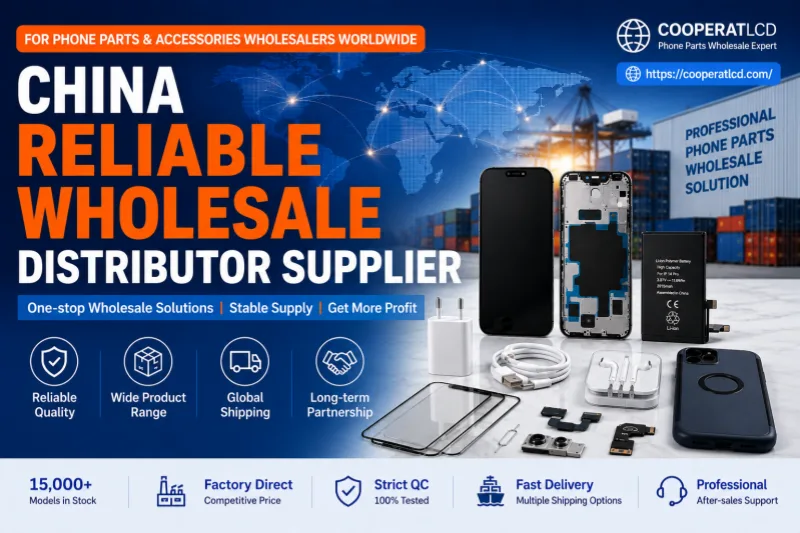
For importers, distributors, repair-chain operators, and wholesale buyers, choosing the right phone parts and accessories supplier is one of the most important decisions in the supply chain. A supplier that offers low prices but inconsistent quality, unstable stock, poor communication, or unreliable delivery can quickly increase your return rate, customer complaints, and operating costs.
The challenge becomes greater when purchasing from overseas suppliers. Buyers need to evaluate not only product quality and pricing, but also manufacturing capability, inventory management, quality control, export experience, packaging, logistics, after-sales service, and long-term cooperation potential.
Here we will explains how to systematically find and evaluate a reliable distribution supplier partner for mobile phone parts and accessories
1. What Makes a Good Phone Parts Distribution Supplier?
A reliable supplier should be more than a company that can provide a product catalog and a low quotation.
For wholesale buyers, an ideal distribution partner should provide a combination of:
- Consistent product quality
- Competitive and transparent pricing
- Stable inventory
- Broad product coverage
- Accurate product specifications
- Professional quality control
- Reliable delivery
- Flexible order quantities
- Efficient communication
- Clear warranty and return policies
- International export experience
- Strong after-sales support
- Ability to support long-term business growth
In other words, the goal should not simply be “find the cheapest supplier.”
The better goal is:
Find the supplier with the best combination of quality, price, reliability, service, and long-term supply capability.
2. Define Your Purchasing Requirements Before Looking for Suppliers
Before contacting suppliers, clearly define what your business actually needs.
This prevents you from comparing suppliers based only on price.
Product RequirementsDetermine which categories you need:
You should also define the models and quality grades you require.
For example, a screen buyer may need different grades such as original, refurbished, aftermarket, or different quality levels of LCD/OLED products.
Order RequirementsClarify:
- Expected monthly purchasing volume
- Average order value
- MOQ requirements
- Number of SKUs per order
- Peak-season demand
- Required lead time
- Preferred shipping method
- Destination countries
- Packaging requirements
- Private-label or OEM requirements
A supplier suitable for a buyer purchasing 50 pieces may not be suitable for an importer purchasing thousands of pieces across hundreds of SKUs.
3. Look for Suppliers Through Multiple Channels
Do not rely on only one source when searching for suppliers.
Potential channels include:
Manufacturer WebsitesSearching directly for manufacturers and professional exporters can help you identify companies with their own production or supply-chain capabilities.
B2B PlatformsB2B marketplaces can be useful for discovering potential suppliers, but buyers should conduct additional verification rather than relying solely on platform ratings.
Industry ExhibitionsTrade shows provide an opportunity to inspect products, packaging, facilities, and samples in person.
Industry ReferralsRecommendations from repair chains, distributors, importers, and other industry participants can be valuable because they are based on actual purchasing experience.
Search EnginesGoogle and other search engines can help buyers identify specialized suppliers by combining product and purchasing keywords, such as:
The important point is to
build a shortlist rather than immediately choosing the price-lowest supplier you find.
4. Verify Whether the Supplier Is a Manufacturer, Distributor, or Trading Company
Not every supplier has the same business model.
A company may be:
- A manufacturer
- A distributor
- A trading company
- A combination of manufacturing and distribution
None of these models is automatically good or bad.
The important question is whether the supplier's capabilities match your purchasing requirements.
For example, a manufacturer may offer strong production capability for certain products but have limited SKU coverage. A professional distributor may provide a much broader selection and better support for mixed-SKU wholesale orders.
For importers who need hundreds or thousands of different phone models,
SKU coverage and supply-chain integration can be just as important as manufacturing capability.
5. Evaluate the Supplier's Product Range
Phone parts are highly model-specific.
A supplier may have competitive pricing but still be inconvenient if you need to purchase from multiple companies to complete your product range.
Ask suppliers:
- How many phone models do you support?
- Which brands do you cover?
- How many SKUs are normally in stock?
- Which products are available for immediate shipment?
- How frequently is inventory updated?
- Can multiple product categories be combined into one order?
A supplier with a broad product portfolio can potentially help importers reduce the number of suppliers they need to manage.
This can simplify:
- Purchasing
- Payment
- Quality inspection
- Consolidated packaging
- Shipping
- Documentation
- After-sales communication
6. Do Not Evaluate Price Without Evaluating Quality
Price is important in wholesale purchasing, but the lowest quotation does not necessarily mean the lowest total cost.
Suppose Supplier A offers a screen at $20, while Supplier B offers it at $18.
At first glance, Supplier B looks cheaper.
However, if Supplier B has a significantly higher defect rate, more returns, inconsistent color performance, poor touch sensitivity, or unreliable packaging, the actual cost may be higher.
A more useful purchasing calculation considers:
Purchase Price + Shipping + Defect Cost + Return Cost + Labor Cost + Customer Compensation + Potential Lost SalesThis is why professional buyers should compare total cost of ownership, rather than unit price alone.
7. Request Samples Before Placing Large Orders
Samples are one of the most effective ways to evaluate a new supplier.
Before committing to a large order, purchase samples and test them under actual operating conditions.
For phone screens, testing may include:
- Display brightness
- Color reproduction
- Touch sensitivity
- Viewing angles
- Dead pixels
- Lines or spots
- Backlight uniformity
- Frame fit
- Proximity sensor compatibility
- Front-camera alignment
- Functional compatibility
For batteries, buyers should consider:
- Rated capacity
- Actual capacity
- Voltage
- Charging performance
- Battery health information
- Physical appearance
- Connector quality
- Protection-board performance
- Swelling or abnormal heating during testing
For charging accessories, test:
- Charging stability
- Output performance
- Connector quality
- Cable durability
- Compatibility
- Heat generation
The exact inspection standards should be adapted to the product category.
8. Examine the Supplier's Quality Control System
A professional supplier should be able to explain how quality is controlled.
Do not simply ask:
“Is your quality good?”
Instead, ask specific questions:
- Is incoming material inspected?
- Are products tested before shipment?
- Is inspection performed on every batch?
- What inspection equipment is used?
- Are inspection records retained?
- How are defective products identified?
- Is serial-number or SKU-level tracking available?
- What happens when a defect is discovered?
- What is the supplier's warranty policy?
A strong quality-control system should be systematic and repeatable, rather than dependent entirely on individual workers.
9. Check Whether the Supplier Can Maintain Consistent Quality
One good sample does not guarantee consistent quality.
This is particularly important for aftermarket phone parts because product specifications can vary between production batches.
Ask whether the supplier can maintain:
- Consistent materials
- Consistent component specifications
- Consistent appearance
- Consistent performance
- Consistent packaging
- Consistent testing standards
If the supplier changes the product grade or component source without informing customers, this can create significant problems for distributors.
For long-term cooperation, buyers should establish clear product specifications and quality standards in advance.
10. Evaluate Inventory and Supply Stability
For distributors, stock availability is often as important as price.
A supplier should be able to provide reasonably accurate information about:
- Current inventory
- Stock turnover
- Replenishment cycles
- Out-of-stock frequency
- Lead times
- New model availability
Ask whether inventory is updated in real time or manually.
If a supplier claims to have thousands of SKUs but frequently cannot fulfill confirmed orders, the large catalog has limited practical value.
A reliable partner should provide
accurate inventory information and realistic delivery commitments.
11. Examine the Supplier's Order Fulfillment Process
A professional wholesale supplier should have a standardized order process.
A typical process may include:
Inquiry → Quotation → Order Confirmation → Stock Confirmation → Payment → Picking → QC → Packing → Shipping → Tracking → After-Sales SupportAsk the supplier how each stage is handled.
You should particularly pay attention to:
- SKU identification
- Quantity verification
- Product inspection
- Packaging
- Shipping documentation
- Tracking numbers
- Error handling
A structured process reduces the risk of incorrect products, missing quantities, and shipment delays.
12. Evaluate Packaging and Shipping Capability
Phone parts can be sensitive to impact, moisture, static electricity, and improper handling.
Ask about packaging standards for different product categories.
For example:
ScreensThey may require:
- Protective film
- Individual packaging
- Shock-resistant materials
- Corner protection
- Appropriate cartons
BatteriesThey require appropriate packaging and transportation procedures because lithium batteries are regulated goods in international transportation.
Small AccessoriesCables, connectors, and other accessories should be separated and clearly labeled to reduce picking errors.
For international buyers, also ask whether the supplier works with multiple shipping channels and whether they can provide appropriate export documentation.
13. Check International Export Experience
A supplier may be excellent domestically but inexperienced in international trade.
For overseas buyers, ask:
- Which countries do you regularly ship to?
- How many years have you handled export orders?
- Can you provide commercial invoices?
- Can you provide packing lists?
- Can you support export documentation?
- Which shipping methods are available?
- Can you handle different destination requirements?
- How are customs-related issues handled?
International experience can significantly reduce communication and logistics problems.
14. Evaluate Communication Quality
Communication is often underestimated when selecting a supplier.
Before cooperation, observe:
- How quickly do they respond?
- Do they answer questions directly?
- Are quotations clear?
- Do they understand technical product specifications?
- Can they communicate in your preferred language?
- Do they proactively inform you about stock changes?
- Do they notify customers when products change?
- Can they resolve problems professionally?
A supplier that responds quickly before receiving an order but becomes difficult to reach after payment is a major warning sign.
15. Ask About Warranty and After-Sales Policies
No supplier can guarantee zero defects.
What matters is how the supplier handles defects when they occur.
Before ordering, clarify:
- Warranty period
- DOA policy
- Defective-product definition
- Evidence required for claims
- Return requirements
- Replacement policy
- Credit/refund policy
- Claim-processing time
- Responsibility for shipping costs
A professional supplier should have a clearly defined after-sales process rather than handling every dispute on an individual basis.
16. Review Payment Terms Carefully
Before placing an order, clarify:
- Accepted payment methods
- Deposit requirements
- Balance payment conditions
- Currency
- Bank charges
- Payment confirmation process
- Credit terms for qualified customers
For new suppliers, avoid committing excessive funds before the supplier's reliability has been established.
A practical approach is to begin with a smaller trial order and gradually increase purchasing volume after successful transactions.
17. Compare Suppliers Using a Standardized Scorecard
Instead of choosing based on personal impressions, create a supplier evaluation system.
| Evaluation Factor |
Suggested Weight |
| Product Quality |
25% |
| Price Competitiveness |
15% |
| Inventory & SKU Coverage |
15% |
| Quality Control System |
10% |
| Delivery & Logistics |
10% |
| After-Sales Service |
10% |
| Communication |
5% |
| Export Experience |
5% |
| Payment & Commercial Terms |
5% |
| Total |
100% |
You can adjust the weights according to your business.
For example, a high-volume distributor may assign more weight to inventory and delivery, while a premium repair chain may prioritize quality and consistency.
18. Warning Signs You Should Not Ignore
When evaluating potential suppliers, pay attention to red flags.
Extremely Low PricesA price significantly below the market level may indicate:
- Different quality grade
- Used or refurbished products
- Inconsistent components
- Hidden costs
- Inaccurate specifications
Always ask why the price is lower.
Unclear Product SpecificationsIf a supplier cannot clearly explain product grade, materials, compatibility, or specifications, be cautious.
Refusal to Provide SamplesA supplier that refuses reasonable sample testing should be carefully evaluated.
Inconsistent InformationIf the website, salesperson, quotation, invoice, and product packaging provide contradictory information, investigate further.
Poor CommunicationRepeated delays in responding to technical or commercial questions can become a serious problem after cooperation begins.
Unclear Warranty PolicyIf warranty terms are vague before an order, resolving claims later may be difficult.
Unstable InventoryRepeatedly accepting orders for products that are not actually available can disrupt your business.
19. Start With a Trial Order
Even after supplier verification, do not immediately transfer your entire purchasing volume to a new supplier.
A trial order allows you to evaluate the supplier under real conditions.
During the trial, measure:
- Order accuracy
- Product quality
- Packaging
- Delivery time
- Communication
- Shipping performance
- Defect rate
- After-sales response
After several successful orders, you can gradually increase purchasing volume.
This reduces the risk of depending on an untested supplier.
20. Build a Long-Term Supplier Partnership
The best supplier relationship should evolve beyond simple transactions.
As cooperation develops, buyers can negotiate:
- Better wholesale pricing
- Volume-based discounts
- Reserved inventory
- Priority allocation for new models
- Faster order processing
- Customized packaging
- Private labeling
- OEM/ODM services
- Credit terms for qualified customers
- Dedicated account management
Long-term purchasing data can also help suppliers better understand your demand patterns and prepare inventory accordingly.
21. Why a Broad-SKU Distribution Partner Can Be Valuable
For many international phone-parts importers, purchasing from multiple specialized suppliers creates additional operational costs.
For example:
Supplier A → ScreensSupplier B → BatteriesSupplier C → Charging AccessoriesSupplier D → Phone CasesThis can increase:
- Communication workload
- Payment transactions
- Quality-control work
- Packaging complexity
- Shipping costs
- Inventory management
- After-sales coordination
A professional distribution partner that can consolidate multiple categories into one purchasing relationship may simplify the entire supply chain.
This is particularly useful for importers serving local wholesalers, repair shops, retail stores, and online sellers.
22. Why Cooperatlcd Can Be Considered as a Wholesale Supply Partner
For international buyers looking for a China-based phone parts and accessories supplier, Cooperatlcd focuses on wholesale supply for customers with bulk purchasing requirements.
Our product coverage can help buyers source multiple categories of mobile phone parts and accessories through one supply relationship, including screens, batteries, cables, chargers, phone accessories, and other repair-related products.
For wholesale customers, the key value is not simply obtaining a low unit price. A reliable supplier should help customers manage the complete purchasing process—from product selection and quality control to inventory coordination and international shipping.
Cooperatlcd's approach emphasizes batch-level quality inspection, SKU management, and structured order processing to support international wholesale customers.
Before establishing long-term cooperation, buyers should still evaluate samples, specifications, pricing, shipping arrangements, warranty terms, and other commercial conditions according to their own requirements.
23. A Practical Supplier Selection Checklist
Before choosing your final supplier, review the following questions:
- Does the supplier have the phone models and SKUs I need?
- Are product specifications clearly defined?
- Can the supplier provide samples?
- Is product quality consistent between batches?
- Does the supplier have a documented QC process?
- Can inventory information be provided accurately?
- Are MOQ and pricing suitable for my business?
- Can the supplier handle mixed-SKU wholesale orders?
- Does the supplier have international export experience?
- Can the supplier provide appropriate shipping and export documents?
- Are packaging standards suitable for international transportation?
- Are warranty and after-sales terms clearly defined?
- Is communication efficient and professional?
- Can the supplier support increasing order volumes?
- Has the supplier successfully completed a trial order?
If most of these questions receive positive answers, the supplier is more likely to be suitable for long-term cooperation.
Conclusion: Choose Reliability, Not Just the Lowest Price
Finding a reliable phone parts and accessories distribution partner requires more than comparing quotations.
For international importers, the most important factors include
product quality, SKU coverage, inventory stability, quality control, pricing, export capability, delivery reliability, communication, and after-sales service.A good supplier should reduce your operational workload rather than create additional problems.
The best approach is to:
Define your requirements → Build a supplier shortlist → Verify supplier capabilities → Test samples → Compare total costs → Place a trial order → Evaluate performance → Gradually build a long-term partnership.For businesses purchasing phone parts and accessories in bulk, selecting the right supplier can directly influence product quality, customer satisfaction, profit margins, and long-term growth.
Cooperatlcd is committed to supporting global wholesale customers with professional phone parts and accessories supply, broad SKU coverage, quality inspection, and international order fulfillment. If you are looking for a dependable China-based distribution partner for your phone parts business, Cooperatlcd can be your long-term suppliers.
[Contact Cooperatlcd Sales Team to Get Your Wholesale Solution]
https://cooperatlcd.com/
https://cooperatlcd.com/pages/contact-us
