Manage your RMA rates effectively! For wholesale distributors and large repair chains, a small screen defect can crush bulk margins. This guide explores the differences between Hard and Soft OLEDs, analyzes why Soft OLEDs fail, and delivers a factory-standard assembly SOP to eliminate installation damage and protect your bottom line. Read now to secure your supply chain!
Unlocking the Secrets of Phone Screens: Hard OLED vs. Soft OLED & How to Prevent Damage During Assembly
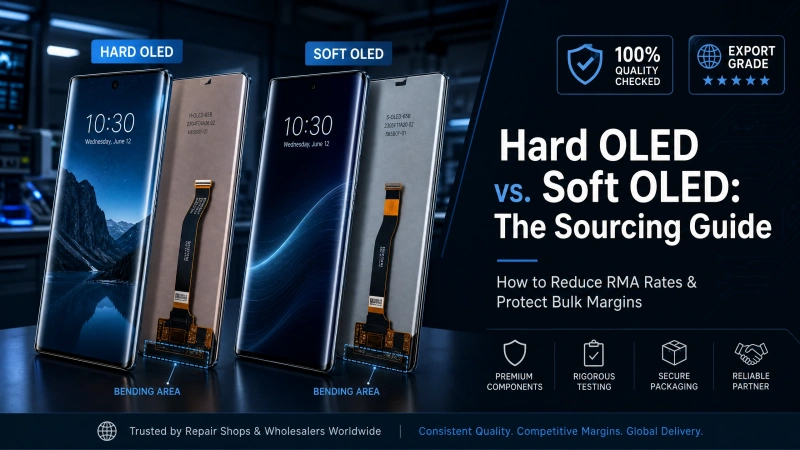
In the global smartphone aftermarket industry, managing RMA (Return Merchandise Authorization) rates is the defining factor between a profitable quarter and a logistical nightmare. For large-scale repair chains and wholesale distributors, a 1% increase in screen defects can instantly erode bulk margins and damage corporate reputations.
With Soft OLED dominating the flagship replacement market, understanding its physical vulnerabilities and enforcing correct assembly protocols is no longer just a task for technicians—it is a critical risk-management strategy for sourcing managers.
As a leading smartphone parts supplier with years of global export experience, we have synthesized this comprehensive guide to help your technical teams eliminate installation damage and protect your bottom line.
Hard OLED vs. Soft OLED: What’s the Real Difference?
The fundamental difference lies in the substrate material used during manufacturing.
| Feature |
Hard OLED |
Soft OLED (Flexible) |
| Substrate Material |
Glass substrate. Rigid, brittle, and completely unbendable. |
Flexible plastic substrate (Polyimide/PI). Can be bent or folded. |
| Bezel Architecture |
Wider bottom bezel (chin) due to flat IC chip and routing space. |
Ultra-narrow bezels. Uses COP (Chip on Plastic) to fold the driver IC behind the screen. |
| Structural Resilience |
Fragile. Vulnerable to internal cracking, line defects, or bleeding under localized pressure. |
High shock absorption. The flexible matrix survives drops, making the inner layer highly shatterproof. |
| Form Factor |
Thicker and heavier profile. |
Ultra-thin, lightweight, matching OEM specifications. |
| Market Positioning |
Budget-friendly. Ideal for cost-sensitive aftermarket repairs and mid-to-low-end models. |
Premium tier. Replicates original flagship performance for curved and high-end displays. |
The 4 Hidden Killers of Soft OLEDs
While the plastic substrate makes Soft OLEDs highly resistant to drop shattering, the internal micro-circuits are incredibly sensitive to precise physical and environmental stress. Here is what causes the dreaded
lines on screen (green/white lines), touch failure, or black spots:
- 💥 Localized Pressure (The COP Matrix): The bottom folding area (the chin) houses microscopic circuitry. Even a slight pinch from a technician’s fingernail during alignment can sever micron-wide trace lines, resulting in the dreaded green/white lines or touch failure.
- 🔩 Screw Mismanagement (Over-penetration): Repairing modern devices requires handling multiple screw lengths. Forcing a long screw into a short screw hole pierces the phone's internal shield plate, instantly puncturing the flexible OLED layer beneath.
- 🔥 Thermal Degradation: Excess heat during frame separation or cleaning degrades the organic light-emitting compounds of the OLED, leading to pixel burnout, discoloration, or delamination.
- 🌪️ Micro-Contaminants: Leftover glass splinters, adhesive residue, or microscopic dust on the middle frame act as localized pressure points. When the screen is clamped and bonded, these particles act as needles, piercing the soft substrate from behind.
Standard Operating Procedure (SOP) for Zero-Defect Installation
To help our global partners minimize installation-induced RMAs, we recommend enforcing the following factory-standard workflow across all repair centers:
📋 The Corporate Repair SOP
- Bare-Screen Verification: Prior to any frame bonding, technicians must perform a full functional test (Display, Brightness, Multi-touch). The screen must be held strictly by the side edges.
- Synchronized Protective Film Removal: When removing the back protective film, it must be peeled off simultaneously with the bracket. Never pull or twist the bracket independently, as this exerts fatal stress on the flexible panel.
- Flawless Frame Preparation: The middle frame must undergo deep cleaning. Ensure it is 100% free of glass fragments, dust, or old glue.
- Biometric & Final Adhesion: Verify under-display fingerprint sensor calibration before applying specialized adhesive for final bonding.
🚫 Strict Industry Prohibitions (Never Do These!)
- ❌ Never use fingernails on the folding area: Always handle screens gently. Keep thumbs and fingernails away from the bottom chin area to prevent permanent line defects.
- ❌ No stamps or labels on the folding zone: Never stamp ink or stick warranty labels on the bottom flexible area. The added micrometer thickness creates uneven pressure points during assembly, causing immediate internal damage.
- ❌ Never pull the bracket separately: Do not pull, wrench, or twist the screen bracket independently while the back protective film is still attached. This causes excessive localized stress, leading to screen puncture or touch failure.
Are you tired of high defective rates, flickering screens, or poor touch sensitivity from unreliable suppliers? Your customers deserve the best, and your bottom line does too.
We supply
factory-grade, premium Soft and Hard OLED screens for all major smartphone brands. Every single batch undergoes strict multi-tier quality control testing to guarantee flawless performance, original color accuracy, and maximum durability.
💼 Why Global Distributors and Large Chains Partner with Us:
- 🔒 Triple-Tier QC Process: Every screen undergoes rigid cosmetic, touch-matrix, and high-refresh-rate testing before leaving our facility to guarantee an industry-leading low RMA rate (<0.5%).
- 📈 Scalable Wholesale Supply: Robust manufacturing backing ensures stable inventory levels and consistent batch quality, even during peak product launch cycles.
- 🌍 Compliant Global Logistics: Optimized customs handling, anti-static shockproof packaging, and reliable express freight options to minimize your transit times and import friction.
- 🛡️ Extended Commercial Warranty: Customized warranty frameworks tailored to fit your high-volume business model and bulk return cycles.
📥 Get a Bulk Quote or Place Your Order Today!
Don't let subpar screens hurt your shop's reputation.
Contact our product experts today to receive our latest inventory catalog, wholesale price sheets, or to place a trial order.
