Different screen types affect not only your costs, but also customer experience, profit margins, and repeat business. In this guide, we’ll break down the differences and help you make the best choice for your repair business.
OLED vs LCD Screens: Which One is Better for Your Repair Business?
In the mobile phone repair industry, screen replacement is one of the most common and profitable services. However, when choosing parts, many repair businesses face a key question:
👉 OLED vs LCD iPhone screen — which one should you choose?
Different screen types affect not only your costs, but also customer experience, profit margins, and repeat business. In this guide, we’ll break down the differences and help you make the best choice for your repair business.
What Are OLED and LCD Screens?
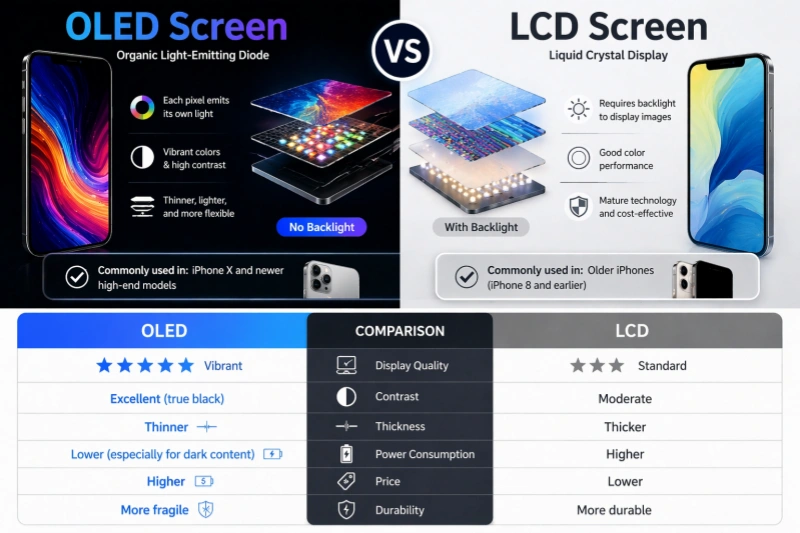
OLED Screens (Organic Light-Emitting Diode)
- Each pixel emits its own light (no backlight needed)
- More vibrant colors and higher contrast
- Thinner and lighter
👉 Commonly used in: iPhone X and newer high-end models
LCD Screens (Liquid Crystal Display)
- Requires a backlight to display images
- Lower cost
- Mature and stable technology
👉 Commonly used in: older
iPhones (iPhone 8 and earlier)
OLED vs LCD: Key Differences
| Feature |
OLED |
LCD |
| Display Quality |
⭐⭐⭐⭐⭐ (vivid) |
⭐⭐⭐ (standard) |
| Contrast |
Extremely high (true black) |
Moderate |
| Thickness |
Thinner |
Thicker |
| Power Consumption |
Lower (especially for dark content) |
Higher |
| Price |
Higher |
Lower |
| Durability |
More fragile |
More durable
|
From a Repair Business Perspective
Cost vs Profit
- LCD Screens
- Lower purchase cost
- Suitable for price-sensitive customers
- Stable margins
- OLED Screens
- Higher cost
- Ideal for premium repair services
- Higher profit per job
👉 Tip: Offer both options to serve different customer segments.
Customer Experience
- OLED
- Closer to original display quality
- Higher customer satisfaction
- LCD
- Slightly dimmer display and thicker bezels
- May affect user experience
👉 Conclusion: High-end customers prefer OLED.
After-Sales & Return Rate
- OLED
- More fragile
- Higher risk if not handled properly
- LCD
- More durable
- Lower return/repair rate
👉 For new repair shops: LCD is easier to manage with lower risk.
Which Screen Should You Recommend?
✔ Recommend OLED for:
- Users with newer/high-end iPhones (iPhone 11 and above)
- Customers who care about display quality
- Those less sensitive to price
✔ Recommend LCD for:
- Budget-conscious customers
- Users who just need a functional replacement
- Basic repair needs
Best Strategy for Repair Shops
To maximize profits and competitiveness, we strongly recommend:
👉 “Dual Product Strategy”
Offer both:
- Premium OLED (high margin)
- Budget LCD (high volume)
Benefits:
- Higher conversion rates
- Broader customer coverage
- Better inventory balance
Market Trends in 2026
- OLED Adoption Continues to Grow
OLED is becoming the mainstream choice
- Growth of Aftermarket OLED
High-quality alternatives to original screens are increasing
- LCD Still Has a Stable Market
Especially in developing regions and budget repairs
Conclusion
When it comes to oled vs lcd iphone screen, there is no absolute “best”—only what fits your business best.
Key Takeaways:
- Target high-end customers → Focus on OLED
- Target budget market → Focus on LCD
- Want to scale → Offer both
Choose a Reliable Supplier to Boost Your Screen Business
Whether you choose OLED or LCD, the quality and reliability of your supplier will ultimately determine your success.
We specialize in mobile phone screens and repair parts wholesale, providing stable, high-quality OLED and LCD solutions to repair businesses worldwide.
Why Choose Us?
- ✅ Strict quality grading (original / premium / budget)
- ✅ Full range of OLED & LCD screens
- ✅ Stable inventory with fast shipping
- ✅ Professional after-sales support
- ✅ Wholesale and customization available
📩 Contact us today to get the latest screen pricing and samples!
Let’s help you grow a more profitable repair business.
