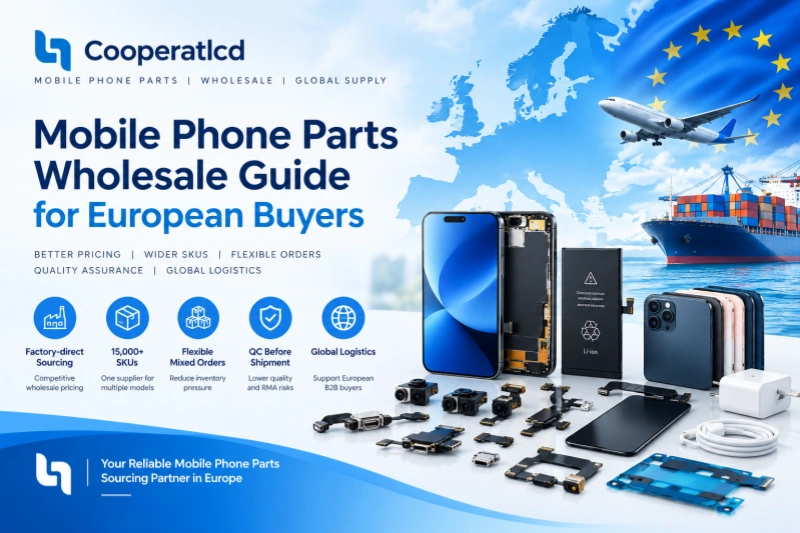
For European phone repair shops, distributors and B2B importers, sourcing mobile phone parts is no longer simply about finding the lowest unit price.
A reliable wholesale partner needs to solve several problems at the same time:
- How can you get competitive wholesale pricing?
- How can you source parts for multiple phone models from one supplier?
- How can you avoid excessive inventory when demand varies by model?
- How can you reduce defective products and RMA costs?
- How can you manage international shipping efficiently?
- How can you maintain a stable supply of fast-moving replacement parts?
This guide explains how European B2B buyers can evaluate mobile phone parts suppliers and build a more flexible sourcing strategy.
For businesses purchasing screens, batteries, charging parts, cameras, housings and other repair components, the right supplier can directly affect gross margin, inventory turnover and customer satisfaction.
1. What Is Mobile Phone Parts Wholesale?
Mobile phone parts wholesale refers to purchasing replacement components in commercial quantities from manufacturers, factories, distributors or specialized B2B suppliers, usually at prices lower than retail or small-quantity purchasing.
Typical wholesale phone parts include:
| Product Category |
Common Wholesale Products |
Typical Buyers |
| Screens |
LCD, OLED, Hard OLED, Soft OLED |
Repair shops, distributors |
| Batteries |
Standard, high-capacity batteries |
Repair businesses |
| Charging Parts |
Charging ports, flex cables, cables |
Repair shops |
| Cameras |
Front/rear camera modules |
Repair centers |
| Audio Parts |
Speakers, earpieces, microphones |
Repair shops |
| Housings |
Back covers, frames, middle frames |
Refurbishers |
| Small Parts |
Buttons, connectors, brackets |
Repair businesses |
| Accessories |
Cases, tempered glass, chargers |
Distributors, retailers |
| Repair Tools |
Opening tools, screwdrivers, equipment |
Repair shops |
For European buyers, wholesale sourcing usually makes sense when monthly demand is high enough to justify
better unit pricing, consolidated shipping and supplier-level purchasing.
2. Why European Buyers Need a Different Sourcing Strategy
The European repair market is becoming increasingly important because smartphones are being kept in use for longer and repairability is receiving more regulatory attention.
Since 20 June 2025, EU ecodesign and energy-labelling rules have applied to smartphones and tablets placed on the EU market. The rules include requirements related to repairability, spare-parts availability and product lifetime. Source:[Energy Efficient Products] [Internal Market & SMEs]
The European Commission states that critical spare parts must be made available for repairers for up to seven years after the end of sales of a product model, with delivery requirements of approximately 5–10 working days under the relevant rules.
This creates an important sourcing implication:
European repair businesses need suppliers that can support a broad range of models over a longer product lifecycle—not just suppliers offering the cheapest current-generation parts.
At the same time, inventory creates a major challenge.
A repair shop may need:
- 10 units of one iPhone screen
- 5 units of another Samsung display
- 8 batteries for Xiaomi models
- several charging flex cables
- a few camera modules
- small quantities of older models
Buying every SKU in large quantities can tie up significant working capital.
Therefore, supplier flexibility becomes almost as important as price.
3. The Main Problem: Cheap Parts Can Become Expensive
When comparing suppliers, European buyers often focus on the purchase price.
But the real procurement cost is more complicated.
Total sourcing cost can be viewed as:Product Cost + Shipping + Defect Cost + RMA Cost + Inventory Cost + Management CostFor example, suppose Supplier A offers a display for €25 while Supplier B offers one for €23.
At first glance, Supplier B appears cheaper.
But if Supplier B has:
- higher defect rates,
- inconsistent batches,
- poor packaging,
- slow replacement,
- limited model availability,
the €2 saving may disappear after returns and customer complaints.
Expert sourcing principleThe lowest unit price is not necessarily the lowest total cost.For professional European buyers, supplier evaluation should therefore include:
- Unit price
- Product quality
- QC process
- SKU availability
- MOQ
- Mixed-order flexibility
- Packaging
- Logistics
- RMA handling
- Communication and after-sales support
4. Wholesale Supplier Comparison: What Should European Buyers Look For?
| Factor |
Traditional Supplier |
Professional Wholesale Partner |
| Pricing |
Product-by-product |
Competitive wholesale structure |
| SKU range |
Limited |
Broad multi-brand inventory |
| MOQ |
Often rigid |
Flexible |
| Mixed orders |
Limited |
Supported |
| QC |
Random or unclear |
Pre-shipment inspection |
| Model coverage |
Narrow |
Multiple brands/models |
| Inventory support |
Buyer manages alone |
Flexible purchasing |
| Logistics |
Single channel |
Multiple shipping options |
| RMA handling |
Reactive |
Structured process |
| B2B support |
Basic |
Dedicated sourcing support |
The goal is not simply to find a supplier.
The goal is to find a
sourcing partner capable of supporting your purchasing model.
5. Step-by-Step: How European Buyers Should Source Mobile Phone Parts
Step 1: Analyze Your Fast-Moving Models
Start with your sales and repair data.
Separate products into:
A — High-volume SKUsFrequently ordered products.
These deserve higher inventory levels.
B — Medium-volume SKUsStable but moderate demand.
These can be replenished regularly.
C — Low-volume SKUsSlow-moving or model-specific products.
Avoid excessive inventory.
This simple ABC approach can prevent cash from being trapped in slow-moving parts.
Step 2: Choose a Supplier With Broad SKU Coverage
A supplier with only a few popular models may force you to work with multiple vendors.
That creates additional:
- communication costs
- payment transactions
- shipping costs
- QC procedures
- inventory management
- supplier coordination
A broader supplier can consolidate more of your purchasing needs.
Cooperatlcd sourcing advantage15,000+ SKUsInstead of sourcing individual models from multiple suppliers, European buyers can use one sourcing channel for a wider range of phone parts.
This is particularly useful for businesses handling multiple brands such as:
- Apple
- Samsung
- Xiaomi
- Huawei
- OPPO
- Other mainstream Android models
One supplier → multiple models → fewer sourcing headaches.
6. Flexible Mixed Orders: A Practical Solution to Inventory Pressure
One of the biggest challenges for smaller European wholesalers and repair networks is MOQ.
Imagine a buyer needs:
- 20 iPhone screens
- 15 Samsung screens
- 10 Xiaomi batteries
- 10 charging flex cables
- 5 camera modules
A rigid MOQ for every SKU could make the order unnecessarily expensive.
A flexible mixed-order model allows buyers to combine different SKUs into one purchasing plan.
Why mixed orders matterTraditional purchasing: Large MOQ → higher inventory → more capital tied upFlexible purchasing: Multiple SKUs → smaller quantities → better inventory controlFor European B2B buyers, this can be especially useful when testing new models or entering a new regional market.
Cooperatlcd sourcing solutionFlexible mixed orders help reduce inventory pressure while allowing buyers to expand SKU coverage.Instead of purchasing large quantities of every individual model, buyers can build an order around actual demand.
7. Factory-Direct Sourcing: Why It Matters
Another important question is:
How many layers are between the buyer and the manufacturer?A longer supply chain can contain:
Factory → Distributor → Wholesaler → Local Supplier → Buyer
Each layer can add margin.
A factory-direct or factory-connected sourcing model can shorten the supply chain:
Factory → Cooperatlcd → European B2B BuyerThis can create advantages in:
- purchasing price
- product information
- customization
- stock coordination
- QC communication
- production feedback
Cooperatlcd positioningFactory-direct sourcingCooperatlcd focuses on supplying mobile phone repair parts directly to international B2B customers, helping buyers access competitive wholesale pricing while reducing unnecessary supply-chain layers.
8. Product Categories European Buyers Can Source
A professional wholesale supplier should ideally cover multiple high-demand categories.
8.1 Mobile Phone Screens
Popular categories include:
- OLED screens
- Soft OLED
- Hard OLED
- Incell LCD
- Refurbished screens
- Aftermarket screens
For screen purchasing, buyers should compare:
- Display quality
- Touch sensitivity
- Brightness
- Color performance
- Frame quality
- Glass quality
- Flex cable quality
- Packaging
- Defect rate
Don't compare screens based only on resolution or price.
8.2 Mobile Phone Batteries
Battery procurement should focus on:
- Capacity
- Battery health
- Cycle performance
- Protection circuit
- Connector quality
- Manufacturing consistency
- Safety packaging
Battery sourcing is particularly relevant to Europe's growing repair and circular-economy ecosystem.
The EU's smartphone ecodesign framework includes requirements around battery durability and spare-parts availability. For example, covered smartphone batteries are expected to withstand at least 800 charge/discharge cycles while retaining at least 80% of initial capacity under the specified requirements.
Source:[Energy Efficient Products]
8.3 Charging Parts
Common wholesale products include:
- Charging flex cables
- USB-C components
- Lightning-related parts
- Charging ports
- Charging cables
- Connectors
These are often suitable for mixed-order purchasing because individual model demand can vary significantly.
8.4 Cameras, Speakers and Small Parts
Other commonly purchased repair components include:
- Front cameras
- Rear cameras
- Earpiece speakers
- Loudspeakers
- Microphones
- Power flex cables
- Volume flex cables
- SIM trays
- Buttons
- Connectors
A broad supplier allows buyers to consolidate these products into the same purchasing cycle.
9. Wholesale Pricing: How Should European Buyers Compare Prices?
There is no single "best wholesale price."
The right price depends on:
- Model
- Part type
- Quality grade
- Quantity
- Order frequency
- Packaging
- Shipping method
- Payment terms
- Supplier relationship
A useful purchasing formula is:
Effective Landed CostLanded Cost = Product Price + Freight + Duties/Taxes + Handling + Expected Defect CostTherefore, when requesting quotations, European buyers should provide:
Model + Part Type + Quality Grade + Quantity + DestinationFor example:
iPhone 14 OLED / Soft OLED / 50 pcs / GermanyThis allows suppliers to provide a more meaningful quotation than simply asking:
"What is your best price?"
10. How to Build a Better Wholesale Order
A professional purchasing order should combine high-volume products with complementary low-volume SKUs.
Example
| Category |
Example Quantity |
Purchasing Strategy |
| Fast-moving screens |
100 pcs |
Higher quantity |
| Medium-demand screens |
50 pcs |
Moderate quantity |
| Batteries |
50 pcs |
Regular replenishment |
| Charging flex |
20 pcs |
Mixed order |
| Cameras |
10 pcs |
Low inventory |
| Small parts |
10–20 pcs |
Order according to demand |
This approach allows buyers to expand their product range without unnecessarily increasing inventory.
11. QC Before Shipment: The Hidden Value of a Supplier
A low purchase price means little if defective products arrive at your warehouse.
For wholesale buyers, QC should happen before shipment, not after the customer discovers the problem.
Recommended pre-shipment QC processStep 1 — Incoming material inspectionCheck incoming components and materials.
↓
Step 2 — Production inspectionMonitor production quality.
↓
Step 3 — Functional testingTest relevant functions according to product category.
↓
Step 4 — Appearance inspectionCheck scratches, cracks, contamination and assembly defects.
↓
Step 5 — Quantity verificationConfirm SKU and quantity.
↓
Step 6 — Packaging inspectionCheck protection against transportation damage.
↓
Step 7 — Final shipment confirmationRelease qualified goods for shipment.
Cooperatlcd advantageQC before shipmentEvery batch should be checked before leaving the supplier's facility, helping buyers reduce:
- defective inventory
- customer complaints
- replacement costs
- RMA rates
- unnecessary return shipping
For B2B buyers, prevention is usually cheaper than after-sales correction.
12. Global Logistics: From China to European Buyers
Product quality and price are only part of international sourcing.
A supplier also needs a practical logistics solution.
European buyers may require different shipping options depending on:
- order size
- urgency
- destination
- product type
- shipping cost
- customs requirements
A flexible logistics strategy can include:Small urgent order→ Express shipping
Regular wholesale order→ Air freight
Large-volume shipment→ More economical freight solutions
Mixed international order→ Consolidated shipment
The right logistics solution should balance:
Cost + Speed + Reliability + TrackingCooperatlcd advantageGlobal logisticsCooperatlcd supports international B2B buyers with shipping solutions designed for different order sizes and destinations.
For European customers, the objective is not simply to ship products internationally, but to make the entire purchasing process easier to manage.
13. Data: Why Repairability Is Becoming More Important in Europe
European smartphone purchasing is taking place within a broader shift toward longer product lifetimes.
The European Commission estimates that the new smartphone and tablet ecodesign rules could generate approximately €20 billion in consumer savings in 2030 and reduce electricity consumption by around 2.2 TWh annually by 2030 compared with the baseline scenario.
[Internal Market & SMEs]The rules also require greater availability of critical spare parts and repair information.
Source:[Energy Efficient Products]This means the European repair-parts market should increasingly be viewed as part of a longer device lifecycle, rather than simply a short-term aftermarket opportunity.
For wholesalers, this creates an important strategic question:
Can your supplier support both today's high-volume models and tomorrow's long-tail repair demand?That is where SKU breadth becomes valuable.
14. Expert Explanation: The "5-Factor Supplier Model"
For professional procurement, Cooperatlcd recommends evaluating suppliers using five dimensions:
1. PriceCan the supplier provide competitive wholesale pricing?
2. BreadthCan one supplier cover enough models and categories?
3. FlexibilityCan you purchase mixed SKUs without excessive MOQ pressure?
4. QualityIs there a documented QC process before shipment?
5. LogisticsCan the supplier reliably deliver internationally?
We can simplify this into:
Supplier Value = Price + SKU Coverage + Flexibility + Quality + LogisticsA supplier that performs well across all five areas can create more value than a supplier that wins on unit price alone.
15. Cooperatlcd: One Sourcing Partner for European B2B Buyers
For European distributors, wholesalers and repair businesses, Cooperatlcd's sourcing model is built around five core advantages.
① Factory-Direct Sourcing
Competitive wholesale pricingDirect sourcing helps reduce unnecessary supply-chain layers and provides European B2B buyers with competitive wholesale pricing.
② 15,000+ SKUs
One supplier for multiple modelsWith more than 15,000 SKUs, buyers can source screens, batteries, charging components, flex cables, cameras, housings and other repair parts through one supplier.
This can reduce the need to manage multiple vendors.
③ Flexible Mixed Orders
Reduce inventory pressureCombine different models and product categories according to your actual demand.
This helps buyers:
- test new models
- avoid excessive stock
- improve inventory turnover
- reduce working-capital pressure
④ QC Before Shipment
Lower quality and RMA risksProducts are checked before shipment to identify potential quality or quantity problems before the order reaches the buyer.
For B2B businesses, this means fewer surprises after delivery.
⑤ Global Logistics
Support European B2B buyersInternational shipping solutions help European customers move products from China to their destination according to order size, urgency and logistics requirements.
16. FAQ: Mobile Phone Parts Wholesale in Europe
Q1. What is the MOQ for wholesale phone parts?MOQ depends on the product category, model and quality grade. Buyers should ask suppliers whether they support mixed-SKU orders rather than evaluating MOQ for individual products only.
Q2. Can I order different phone models together?Yes. A flexible mixed-order system is particularly useful for repair businesses and distributors handling multiple brands.
Q3. What phone parts are most suitable for wholesale?Common categories include:
- Screens
- Batteries
- Charging parts
- Flex cables
- Cameras
- Speakers
- Housings
- Small repair components
The best product mix depends on local demand.
Q4. How should I compare wholesale screen prices?Compare the same model, same quality grade, same specification and similar quantity. Then calculate the landed cost rather than comparing the unit price alone.
Q5. How can I reduce defective parts?Choose suppliers with:
- documented QC procedures
- functional testing
- pre-shipment inspection
- batch traceability
- clear RMA procedures
Q6. Is buying directly from China cheaper?It can be, particularly for commercial-volume purchasing, because buyers may reduce intermediary layers. However, the supplier's quality control, logistics capability and after-sales service must also be considered.
Q7. Can European repair shops buy from Cooperatlcd?Yes. Cooperatlcd's B2B sourcing model is designed for international wholesalers, distributors, repair businesses and other commercial buyers.
Q8. Can I request a mixed quotation?Yes. Buyers can provide a list of models, quantities and product categories and request a consolidated wholesale quotation.
17. European Buyer Wholesale Checklist
Before placing your next order, check the following:
Supplier☐ Factory/direct sourcing capability
☐ B2B wholesale experience
☐ Multiple product categories
☐ Broad SKU coverage
Products☐ Correct model
☐ Correct quality grade
☐ Consistent specifications
☐ Functional testing
Purchasing☐ Competitive wholesale price
☐ Flexible MOQ
☐ Mixed-order capability
☐ Clear quotation
Quality☐ Pre-shipment QC
☐ Quantity verification
☐ Packaging inspection
☐ RMA process
Logistics☐ Shipping options
☐ Tracking
☐ Delivery time
☐ Destination support
18. The Bottom Line: Don't Just Buy Parts—Build a Better Supply Chain
For European mobile phone repair businesses and distributors, successful wholesale sourcing is not simply about finding the cheapest supplier.
A better sourcing strategy combines:
The right supplier can help you reduce purchasing costs, control inventory, expand your product range and reduce quality-related risks.
And this is where Cooperatlcd aims to become more than a parts supplier.One supplier.15,000+ SKUs.Flexible sourcing.QC before shipment.
Global B2B logistics.
Ready to Build Your European Wholesale Order?
Whether you are a phone repair shop, distributor, importer, wholesaler or refurbishment business, send Cooperatlcd your product list and target quantities.
We can help you evaluate:
- Product availability
- Wholesale pricing
- Mixed-order options
- Product quality grades
- QC requirements
- Shipping solutions
Tell us what models and quantities you need.Get Your Wholesale Quote → Contact Cooperatlcd


