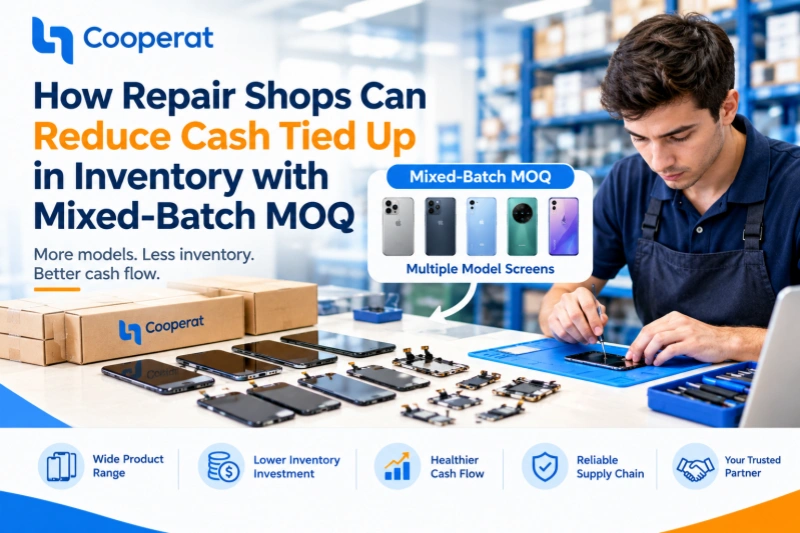
For mobile phone repair shops, maintaining the right inventory is a constant balancing act.
You need enough
mobile phone spare parts to repair popular devices quickly, but buying too many replacement screens, batteries, charging ports, and other components can tie up valuable cash. This becomes even more challenging when your customers use many different phone models.
One practical solution is
mixed-batch MOQ (Minimum Order Quantity).
Instead of purchasing a large quantity of a single model, repair shops can work with a supplier that allows multiple models or SKUs to be combined within one order. This approach can help businesses maintain a wider product range while controlling inventory investment.
At
Cooperat, we have more than 20 years of experience in
mobile phone spare parts export and wholesale from China. We work with repair shops, wholesalers, distributors, and other international buyers, helping them source replacement parts according to their product requirements and purchasing volumes.
In this guide, we explain how
mixed-batch MOQ works, why it matters for repair shop cash flow, and how to build a more efficient purchasing strategy.
What Is Mixed-Batch MOQ?
MOQ means
Minimum Order Quantity. It is the minimum quantity a supplier requires a customer to purchase for an order or a specific product.
With a traditional MOQ, a supplier may require a buyer to purchase a certain number of units for each individual SKU.
For example:
- 20 pieces of iPhone Model A
- 20 pieces of Samsung Model B
- 20 pieces of Xiaomi Model C
For a large distributor, this may not be a problem.
For a small or medium-sized repair shop, however, buying 20 or more pieces of every model can create excessive inventory.
How Does Mixed-Batch MOQ Work?
With a mixed-batch MOQ, different products or models may be combined to meet the supplier's total MOQ, depending on the supplier's policy.
For example, instead of purchasing:
20 pieces of one modela repair shop may be able to purchase:
- 5 pieces of Model A
- 5 pieces of Model B
- 5 pieces of Model C
- 5 pieces of Model D
Total: 20 piecesThe exact MOQ, SKU combination, and minimum quantity per model depend on the supplier and product category, so buyers should always confirm the terms before placing an order.
The main benefit is flexibility:
you can potentially stock more models without purchasing a large quantity of every individual SKU.
Why Inventory Can Tie Up Cash for Repair Shops
Inventory is an important business asset, but it also represents money that has already been spent.
For a
mobile phone repair shop, cash tied up in inventory cannot be used elsewhere until those products are sold.
For example, working capital may also be needed for:
- Rent and utilities
- Employee salaries
- Repair tools and equipment
- Shipping and logistics
- Marketing
- New phone models
- Emergency purchases
- Other operating expenses
This is why inventory management is not simply about getting the lowest wholesale price.
A better question is:
How much inventory do I need to serve customers without putting too much cash into slow-moving products?This is where flexible MOQ can become valuable.
5 Ways Mixed-Batch MOQ Can Help Repair Shops Manage Cash Flow
1. Reduce the Amount of Cash Invested in One SKU
One of the biggest risks of traditional bulk purchasing is over-investing in a single product.
Suppose a repair shop purchases 50 replacement screens for one phone model.
If customer demand is strong, the inventory may sell quickly.
But if demand is weaker than expected, the shop may have a large amount of money sitting in unsold stock.
With a mixed-batch order, the same purchasing budget can potentially be distributed across multiple models.
For example:
| Model |
Quantity |
| Model A |
5 PCS |
| Model B |
5 PCS |
| Model C |
5 PCS |
| Model D |
5 PCS |
| Model E |
5 PCS |
| Model F |
5 PCS |
Instead of putting most of the budget into one SKU, the shop gains broader product coverage.
2. Stock More Phone Models With Less Inventory per Model
Customers do not all use the same smartphone.
Depending on the market, a mobile phone repair shop may receive requests for:
If a supplier requires high MOQ for every SKU, stocking a wide range of models can become expensive.
Mixed-batch purchasing can make it easier to test several models at lower quantities.
This is particularly useful for repair shops that want to expand their product coverage without immediately building a large warehouse.
3. Test New Products Before Buying in Bulk
Demand forecasting is difficult, especially when a new smartphone modelscreen enters the market.
A repair shop may not know whether a particular replacement screen or component will become a fast-moving product.
Instead of making a large purchase immediately, a smaller initial quantity can be used to test demand.
A practical purchasing cycle could look like this:
Step 1 — Test
Order a small quantity of a new or uncertain product.
Step 2 — Track
Monitor how quickly the product is sold or used for repairs.
Step 3 — Analyze
Compare sales velocity with other SKUs.
Step 4 — Replenish
Increase the quantity of products with stronger demand.
Step 5 — Reduce
Lower purchases of slow-moving products.
This creates a simple:
Test → Measure → Replenish
inventory strategy.
4. Reduce the Risk of Dead Stock
Dead stock is inventory that remains unsold or unused for an extended period.
For
mobile phone spare parts, dead stock can be particularly challenging because smartphone models and consumer demand change over time.
If a repair shop purchases too many replacement parts for a low-demand model, those products may remain in storage for months.
Mixed-batch purchasing can reduce the amount of capital exposed to each individual SKU.
It does not eliminate inventory risk, but it can help distribute that risk across a wider product mix.
5. Keep More Cash Available for Replenishment
One of the most important benefits of better inventory management is maintaining purchasing flexibility.
Imagine that a repair shop spends almost its entire monthly purchasing budget on a large order.
A week later, several popular models suddenly generate strong repair demand.
The shop may not have enough available cash to replenish those fast-moving parts immediately.
By avoiding excessive purchases of slow-moving SKUs, the business can keep part of its working capital available for replenishment.
In other words:
Inventory efficiency is not only about what you buy. It is also about how much cash you keep available for what you need next.
Mixed-Batch MOQ vs. Traditional Bulk MOQ
The difference can be summarized simply.
| Traditional Bulk Purchasing |
Mixed-Batch Purchasing |
| Higher quantity per SKU |
Smaller quantity per SKU |
| More cash concentrated in individual products |
Cash distributed across multiple products |
| Greater risk of slow-moving stock |
More flexibility to test demand |
| Suitable for high-volume distributors |
Useful for repair shops and smaller buyers |
| Fewer models may be stocked |
More models can potentially be tested |
| Replenishment may require larger purchases |
Potentially more flexible replenishment |
Neither purchasing model is suitable for every business.
Large distributors with predictable demand may prefer higher-volume purchasing.
Repair shops with many different customer requests may benefit from greater purchasing flexibility.
The right approach depends on sales volume, local market demand, available cash, product turnover, and supplier terms.
How to Build a Smart Mixed-Batch Order
Mixed MOQ works best when it is based on actual repair and sales data.
Instead of purchasing products randomly, divide your inventory into three groups.
Group A: Fast-Moving Phone Parts
These are products that are regularly requested by customers.
Examples may include replacement screens, batteries, charging components, or other parts for popular smartphone models.
Consider allocating a larger portion of your purchasing budget to these SKUs.
Group B: Medium-Moving Products
These products have regular demand but do not sell as quickly.
Maintain moderate quantities and monitor their turnover.
Group C: Slow-Moving or Uncertain Products
These may include older models or newly introduced products with uncertain demand.
Use smaller quantities when possible and avoid excessive inventory until you have more sales data.
A simple strategy looks like this:
| Inventory Type |
Purchasing Approach |
| Fast-moving |
Higher quantity |
| Medium-moving |
Moderate quantity |
| Slow-moving |
Smaller quantity |
| New/uncertain |
Test quantity |
The goal is not simply to reduce purchasing volume.
The goal is to allocate your purchasing budget according to actual demand.
Example: How a Repair Shop Could Use Mixed MOQ
Suppose a repair shop has a monthly spare-parts purchasing budget of $3,000.
Instead of using most of the budget to purchase large quantities of a few models, the shop could divide its order across several categories.
For example:
Fast-moving productsAllocate a larger portion of the budget to models with consistent repair demand.
Medium-moving productsPurchase moderate quantities to maintain availability.
New modelsPurchase smaller quantities to test customer demand.
Slow-moving modelsKeep quantities low and replenish only when necessary.
The exact allocation should be based on the shop's own sales data.
This approach can help create a more flexible inventory cycle:
Purchase → Repair/Sell → Track → Replenish → AdjustOver time, purchasing decisions become increasingly data-driven.
What Should Repair Shops Ask a Mobile Phone Parts Supplier?
Before placing a wholesale order, repair shops should clarify the supplier's MOQ and purchasing conditions.
Here are 10 questions worth asking:
1. What is the MOQ?
Ask whether MOQ applies to the entire order or each individual SKU.
2. Can different phone models be mixed?
This is one of the most important questions when purchasing mixed batches.
3. Is there a minimum quantity per SKU?
A supplier may allow mixed orders but still require a minimum quantity for each model.
4. Can different product types be combined?
For example, ask whether different replacement parts can be included in the same order.
5. What product grades are available?
For LCDs and other replacement parts, ask about available quality levels and specifications.
6. What is the lead time?
A low MOQ is less useful if replenishment takes too long.
7. Can the supplier support repeat orders?
Consistent replenishment can be important for repair shops.
8. What is the quality inspection process?
Ask how products are inspected before shipment.
9. What is the warranty policy?
Understand the supplier's policy before placing a wholesale order.
10. Can products be consolidated for shipping?
Combining products into one shipment may help simplify logistics and purchasing.
How Cooperat Supports Flexible Mobile Phone Spare Parts Purchasing
At
Cooperat, we have
more than 20 years of experience in China's mobile phone spare parts export and wholesale industry.Over the years, we have worked with different types of international buyers, including repair shops, wholesalers, distributors, and businesses that need regular replacement-part supplies.
We understand that a local repair shop and a large distributor do not necessarily have the same purchasing requirements.
A distributor may need large quantities of a limited number of high-volume SKUs.
A mobile phone repair shop may need:
- More phone models screens
- Smaller quantities per SKU
- Flexible MOQ
- Reliable quality
- Repeat replenishment
- Efficient international shipping
That is why we focus on understanding the customer's actual purchasing requirements before recommending an order.
Instead of simply asking:
"How many pieces do you need?"we prefer to understand:
"Which phone models do you repair, which parts move fastest, and what quantity fits your purchasing plan?"This helps us discuss a more suitable product mix and MOQ structure.
Why Work With an Experienced China Mobile Phone Spare Parts Supplier?
When purchasing from China, price is only one part of the decision.
A reliable supplier can also affect:
- Product consistency
- MOQ flexibility
- Order accuracy
- Quality control
- Packaging
- Lead time
- Replenishment
- Communication
- International shipping
For repair shops and wholesalers, these factors can directly affect the overall purchasing experience.
With more than two decades of export and wholesale experience, Cooperat understands the importance of clear communication and stable supply for international customers.
Our goal is not simply to ship one order.
We aim to develop
long-term supplier relationships with customers who need ongoing mobile phone spare parts.
Frequently Asked Questions About Mixed-Batch MOQ
What does MOQ mean in mobile phone spare parts?
MOQ means Minimum Order Quantity. It refers to the minimum quantity a supplier requires a buyer to purchase for an order or product.
The MOQ may apply to the total order, individual SKU, or product category depending on the supplier.
What is mixed-batch MOQ?
Mixed-batch MOQ allows different models or SKUs to be combined to reach a supplier's required minimum order quantity, subject to the supplier's terms.
For example, instead of buying 20 pieces of one model, a buyer may be able to purchase smaller quantities of several models that together meet the total MOQ.
Is mixed MOQ suitable for small repair shops?
It can be useful for small and medium-sized repair shops that need multiple phone models but do not want to purchase large quantities of every SKU.
However, the most suitable MOQ depends on the shop's demand, purchasing budget, and product turnover.
Can I mix different phone brands in one order?
This depends on the supplier's MOQ policy and product category.
Before ordering, ask whether Apple, Samsung, Xiaomi, Huawei, OPPO, vivo, or other brands can be included in the same mixed order.
Does a lower MOQ always mean a lower total purchasing cost?
Not necessarily.
A lower MOQ may provide greater purchasing flexibility, but buyers should also consider unit price, shipping cost, product quality, warranty, lead time, and inventory turnover.
The best purchasing decision should consider the total cost and cash-flow impact, not MOQ alone.
How can I choose the right quantity for each phone model?
Start with your sales and repair data.
Identify your fast-moving, medium-moving, and slow-moving products. Purchase larger quantities of consistently high-demand parts and smaller quantities of uncertain or slow-moving products.
Can Cooperat help me build a mixed-batch order?
Yes. You can provide us with your target phone models, product types, estimated quantities, and purchasing requirements.
Our team can then discuss available products, MOQ options, and a suitable order combination with you.
Final Thoughts: Use Your Inventory Budget More Efficiently
For a mobile phone repair shop, having the right parts available is essential—but holding too much inventory can put unnecessary pressure on cash flow.
Mixed-batch MOQ provides a practical way to balance product variety, purchasing flexibility, and inventory investment.
By purchasing smaller quantities across multiple models, testing demand, monitoring product turnover, and increasing quantities for fast-moving parts, repair shops can build a more flexible purchasing system.
The key is not simply to buy more or buy less. It is to buy smarter.
Talk to Cooperat About Your Next Spare Parts Order
If you are looking for a
China mobile phone spare parts supplier and want to explore
flexible MOQ or mixed-batch purchasing,
Cooperat is ready to discuss your requirements.
With 20+ years of experience in mobile phone spare parts export and wholesale, we can help you review your product list and discuss a purchasing solution based on your target models and quantities.
Send us your phone models, product requirements, and estimated quantities.
Our team will review your list and discuss:
- Available replacement parts
- Mixed-batch MOQ options
- Suitable quantities
- Product specifications
- Wholesale pricing
- Shipping arrangements
- Replenishment requirements
Have a product list ready? Contact Cooperat today and let's discuss how we can build a more flexible spare-parts purchasing plan for your business.
https://cooperatlcd.com/
https://cooperatlcd.com/pages/contact-us


